
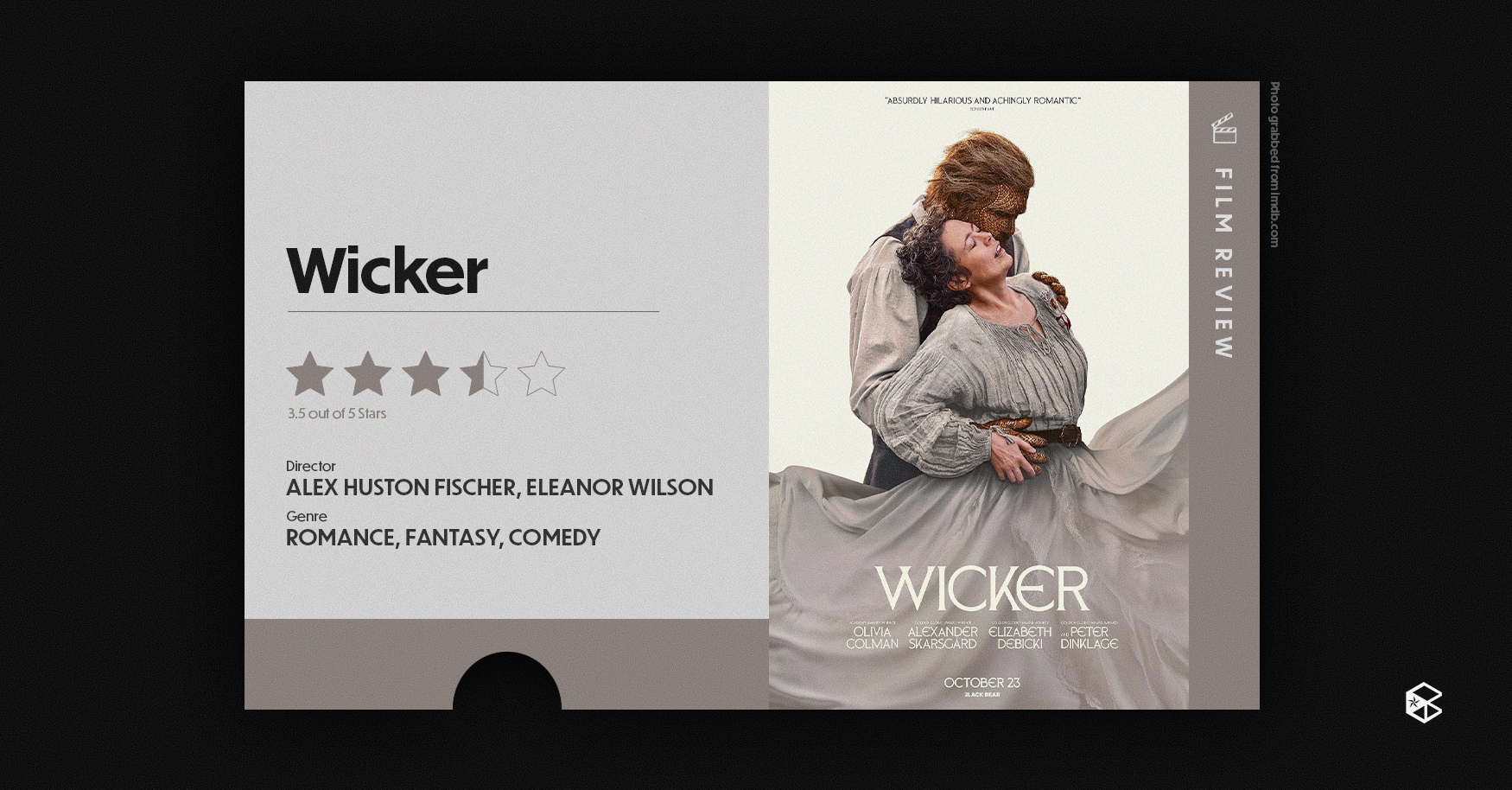




Coming in with a bang strong enough to break the bed, Wicker, released on Oct. 23, promises viewers the ride of a lifetime—brimming with sharp satire, medieval drama, and sensual passion. However, upon closer inspection, this unconventional romance proves to be more than what meets the eye, revealing deeper themes beneath its whimsical surface.
Turning the pages with a teaser trailer leaving fans of the romantic-fantasy genre on the edge of their seats, Alex Huston Fischer and Eleanor Wilson, directors of Save Yourselves! (2020), present Wicker. Transforming a charming fable into a dark adult fairytale, the film made its worldwide premiere on Jan. 24 at the 2026 Sundance Film Festival before its theatrical release in October. With its raunchy scenes and an even spicier atmosphere, audiences flocked to 4DX theatres for the full immersive experience.
Turning the pages of origin
Before making its way to the big screen, this tale began when author Ursula Wills penned the 14-page short story “The Wicker Husband” after a burst of inspiration upon seeing wicker statues during a holiday trip. The fable-style short story follows an ostracized fisherwoman who commissions the village’s basket weaver to craft her a husband. Woven from fine willow fibers, the wicker husband’s marriage to the fisherwoman stirs up a fuss among the villagers.
In adapting the short story, writer-directors Fischer and Wilson emphasized the intimate relationship between the fisher woman, played by Oscar winner Olivia Colman, and the wicker husband, played by Emmy winner Alexander Skårsgard, recognizing its potential for a more intimate and provocative retelling. While Wills praised the film for remaining faithful to her original story, its main appeal lies in the moments when its satirical commentary about marriage and sex shines through the whimsical lens of the narrative.
Where enchantment brings stories to life
Beyond its storytelling, the film’s magic comes alive through Anna Meredith’s witty musical score, managing to capture both the oddity and curiosity viewers feel throughout the film. With each pluck of a string and whistle of a flute, viewers are drawn deeper into the mysticism unfolding on-screen.
Accompanied by intricately designed graphics to signal each act, period-inspired costume designs, and unique set productions, the elements of the film weave into a harmonious visual spectacle that dares viewers to stick around.
An odd love story
At first glance, the relationship between the two leads follow an unconventional trope that plays into the monster romance subgenre. However, once viewers manage to look past the steam and peer beneath the broken bed, this retold fairytale about the outcast woman and a “beast” reveals an underlying commentary on patriarchal norms and their effects on interpersonal relationships.
Underneath that charming gaze and gleaming varnish, the wicker husband’s character serves as a cause of discomfort for the villagers and raises a lingering question to the viewers. His role in the story does not align with the expectations of a husband, nor does it conform to the village’s established rules of marriage. His devotion to his spouse is not born out of an obligation. It is of his own will—and for that, he is painted as a threat.
The fisherwoman on the other hand, has long been ostracized and shunned for her differences and nonconformity, subjecting her to harsh remarks that hint at a deeply rooted system she seeks to escape. While her resistance is subtle, it is reflected in the film’s symbolism, from naming conventions to village traditions, allowing viewers to see how patriarchal norms can turn love into a “burden,” rather than a “prize.”
To love without shackles
Going into this film, viewers may expect an exciting yet unusual romance reminiscent of familiar tropes that leave them reeling. The unexpected chapter, however, lies in the tenderness that comes with a love that is chosen. When one is not robbed of their agency, and when marriage is neither defined by a collar around one’s neck nor comes at the cost of one’s identity, perhaps the true magic lies not in what was seen, but in what is felt.
For a story filled with enchantment and mystical creatures, where the love interest is a man woven of a tree, the real wonder lies in a love that is neither burden nor prize. A love without shackles, where the warmth of desire is felt in the palm of a wooden hand. A love bound by wicker, splinters and all.
Wicker is now showing in Philippine theatres!
