
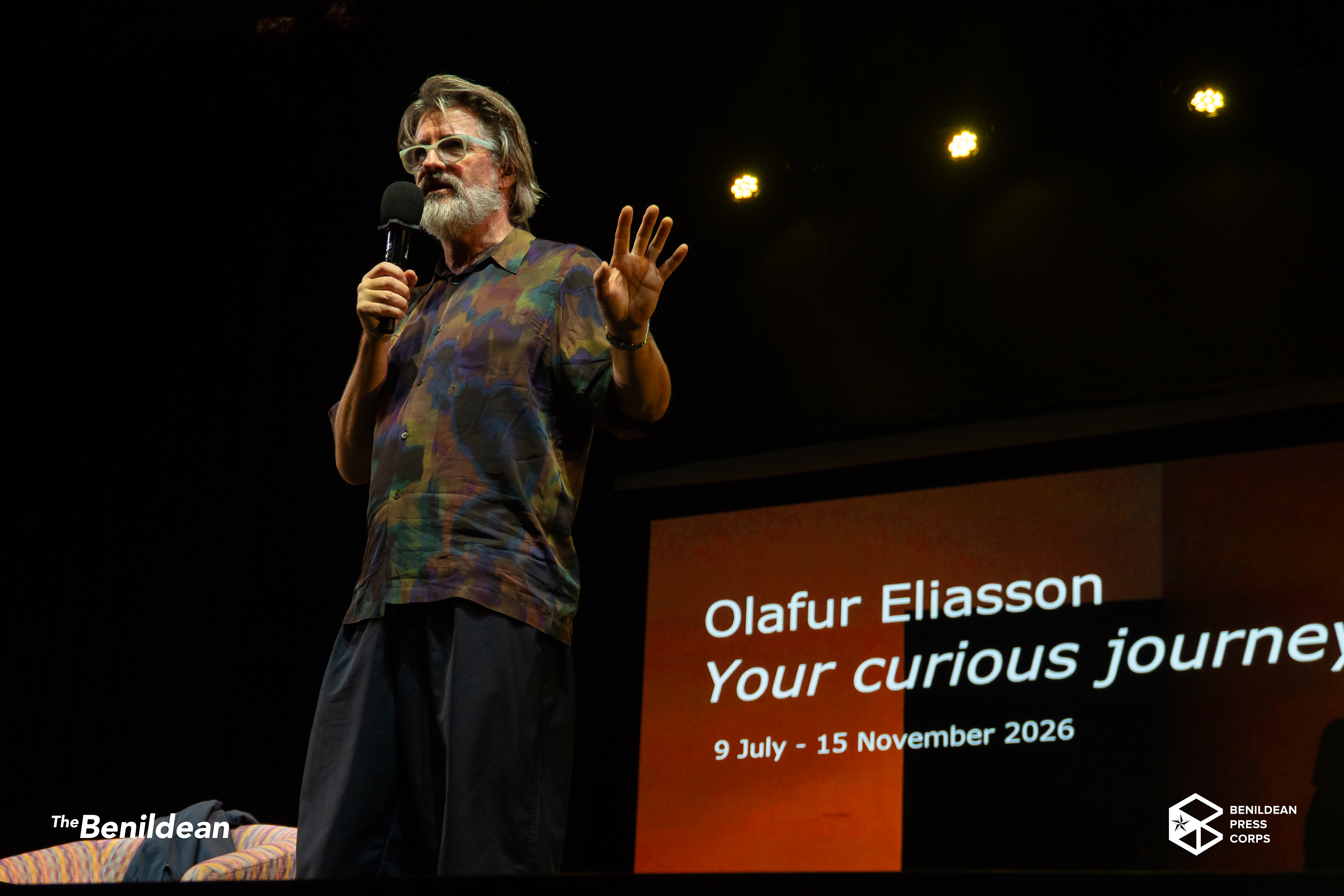




Olafur Eliasson, the artist behind “Your Curious Journey,” an exhibition at the Museum of Contemporary Art and Design (MCAD) Manila, held a special lecture on Nov. 14 at the 5/F Theater, Design and Arts (D+A) Campus, encouraging audiences to make the invisible visible through the engagement of their bodies, minds, and sense of presence.
In a world that constantly demands people to keep moving, Eliasson’s talk offered a different approach to creativity. Through curiosity and experimentation, the lecture explored how taking the time to observe one’s surroundings can reshape the way people view and experience art.
Following the lecture, attendees were given the opportunity to visit the exhibition, where they could encounter the ideas discussed throughout Eliasson's installations.
Curiosity as an artistic practice
Eliasson explained that his practice is based on a readiness to take ideas further than they can immediately go. Instead of restricting his practice to traditional processes of art-making, he explores his surroundings with curiosity and experimentation, letting everyday observations evolve into creative ideas.
His works show how people interact with the world around, particularly through elements of everyday experiences often overlooked. This is visible in his works such as the “Yellow corridor” (1997), a hallway in monofrequency light that transforms how the eye perceives form, and “Beauty,” (1993) a dark room lit through a spotlight intercepting a fine mist of water to create a rainbow.
He added that art is not something that is just looked at and admired; it should never be about the artist's intent as viewers should make their own interpretations through their experiences and interactions. Enquiry and experimentation make it possible to see how a simple thing can be meaningful.
“Slowing down is speeding up because you see more," Eliasson said, discussing that creating art doesn’t always begin with an answer, but that it starts with the openness to ask questions and see what something can grow into.
The art of slowing down
Eliasson’s emphasis on slowing down and asking the audiences to step back and recognize the importance of experiences and elements they might otherwise take for granted, he highlighted, is an opportunity to enjoy and understand what is already around us.
An organizer behind the exhibit shared a similar sentiment, emphasizing how easily people can become caught up in the pace of today's world. “Since in life nowadays, we're so focused on so many things and moving forward. And it's also just a reminder that it's important to slow down and look around, really. See what's beautiful in front of you,” they explained.
One of the talk’s main themes is that curiosity begins when there’s enough time and room to let it grow, and that once it blooms, creativity follows. The organizer expounded that, “we're asking people to be curious, sparking curiosity, which is a very important thing for us. We should approach art in a way that's stemming from being curious and experimental.”
Looking at the bigger picture
Eliasson's artistic practice also explores people’s relationship with nature. Through his use of natural elements, his works encourage audiences to look more closely at the world around them and reconsider how they interact with it—particularly amid the growing concerns of consumerism and climate change.
Decreasing one’s pace also benefits the world in ways more than just fueling artistic growth. The organizer interjected that the improvement of the planet’s state “definitely starts from asking questions, being curious [as] slowing down and reflecting [helps with] being more aware of your surroundings and your movement.”
For Gian Daquiz, an audience member from the University of the Philippines, the urgency with which people navigate everyday life also reflects a larger problem. “The reason why climate change is so adamant is because of how quickly we move around the world [...] I feel it too as a person. I feel like everything is going too fast. I feel rushed and everything,” he shared.
Art beyond its physicality
The lecture also explored the idea of embodiment—where audiences become active participants in experiencing art. By reminding people how to view an artwork, Eliasson invites them to take a participatory role in experiencing and feeling a work, rather than passively observing it. His approach challenges the traditional perception of art as something meant only to be viewed, allowing audiences to form personal connections through physical interaction.
“I feel like we’ve created a culture when you go to museums, not to appreciate the work but to take photos with it,” Daquiz shared, offering a new perspective on the growing popularity of Eliasson’s installations. He pointed out how online conversations about the exhibitions often revolve around the photo opportunities instead of the ideas behind the installations.
This becomes especially important in a culture that rarely allows room for stillness. Daquiz recalled watching visitors move quickly between installations, taking photographs before immediately heading to the next one. Reflecting on this, he remarked that “art is about pause and provocation. So when you don't even pause to see the meaning or to see it without the pressure of taking a photo, how can you be creative with it?” he explained.
Emphasizing on what is more to the piece, there is value in looking beyond its visual appeal and the importance of considering the interpretation it invites.
Take a breather and explore the world through a curious lens by following MCAD on their website, and Facebook and Instagram pages.
