
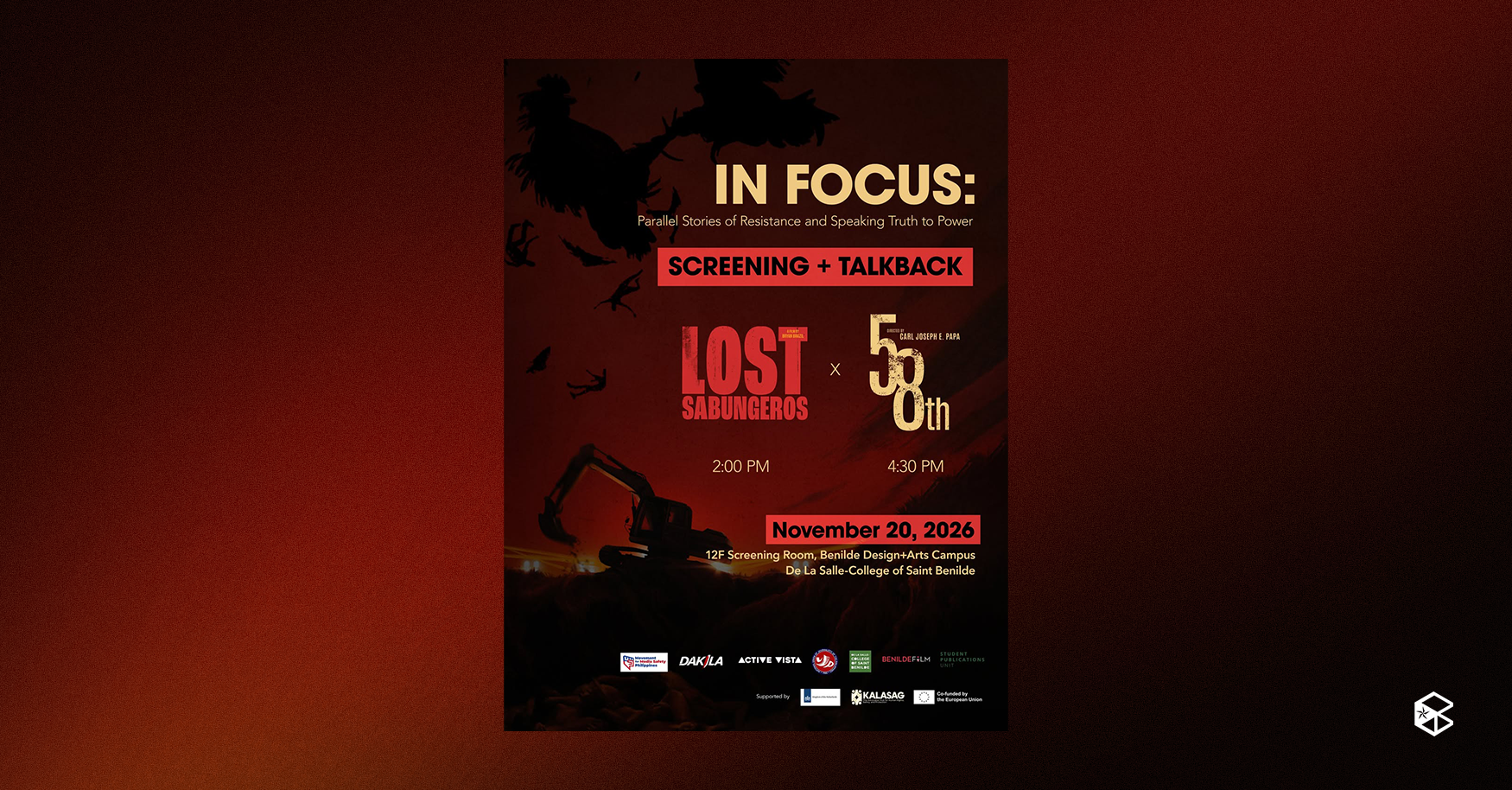




“IN FOCUS: Parallel Stories of Resistance and Speaking Truth to Power” held a back-to-back screening and talkback session of “Lost Sabungeros” and “58th” on Nov. 20 at 12/F Screening Room, Design and Arts (D+A) Campus to bring together two accounts of injustice to the big screen.
The event formed part of the BenildeFilm Experiences Week (BFX Week), which premieres films ranging from different genres all focusing on critical engagement with contemporary issues. It also coincided with the “58th” Campus Tour, a nationwide initiative to showcase the film to colleges and universities to engage younger audiences in conversations about the continuing pursuit of justice.
Organized by the National Union of Journalists of the Philippines (NUJP), Movement for Media Safety PH (MMSP), DAKILA, Active Vista, BenildeFilm, and the Benilde Student Publications Unit (SPU), the event brought together organizations working across film, journalism, and advocacy. Supported by the Embassy of the Netherlands in the Philippines and Kalasag, the initiative also provided a platform for diverse group of people to have a meaningful exchange.
Behind the lens
More than 30 cockfighting enthusiasts disappeared in separate incidents across the Philippines, leaving behind families who continue to seek answers. Directed by Bryan Kristoffer Brazil, “Lost Sabungeros” is the very first feature-length investigative documentary produced by GMA Public Affairs and GMA Pictures.
The film examines cases against the backdrop of the online cockfighting industry—which grew during the pandemic after physical arenas were forced to close. Through interviews with the families, testimonies from three whistleblowers, and investigative footage, the film traces the circumstances surrounding the disappearances and the lives of those left behind.
Accompanying the screening of “Lost Sabungeros”, is “58th” by director Carl Joseph Papa, which revisits the 2009 Maguindanao massacre through the story of Reynaldo "Bebot" Momay, a photojournalist whose remains were never recovered. The animated documentary follows his daughter, Maria Reynafe Castillo, as she seeks recognition for her father as the massacre's 58th victim.
Combining archival footage with dramatized reenactments rendered through rotoscoping, an animation technique wherein frames are drawn over real footage, the film reconstructs the events surrounding the tragedy while placing the family's experience at the center of its narrative.
Hard cut
Getting these stories onto the screen, however, proved to be a challenge in itself. “Lost Sabungeros” was unable to proceed with regular commercial distribution because it remained without an MTRCB classification. The board cited concerns involving ongoing legal proceedings and requested additional documents before reviewing the film—a position publicly disputed by GMA Public Affairs.
In the absence of a classification, the documentary turned to alternative screening venues to reach its intended audience.
“58th” likewise encountered difficulties securing permission for commercial exhibition due to sub judice concerns. These stemmed from the ongoing court proceedings involving the family’s pursuit of official recognition, as well as the film’s depiction of events connected to active court appeals. However, it eventually received an R-16 rating and a limited permit which allowed it a seven-day theatrical run at Shangri-La Plaza in Sept. 2026.
While the two films had different release outcomes, both faced regulatory hurdles that influenced the ways audiences could access their stories.
During the talkback for “Lost Sabungeros,” NUJP Secretary-General Paul Soriano stressed that the importance of telling these stories lies in remembering that there are real lives behind the cases. “These are not just numbers. Lahat ng ito may mukha. Lahat ng ito may pamilya. Lahat may pangarap na sinira. Lahat inuulila,” he stated.
Continuing on the discussion, Mary Zeliet Paris, the co-director and screenwriter of “Lost Sabungeros,” explained that the documentary’s lack of a definitive resolution was intentional, exclaiming that, “wala kaming conclusion. We still don't know the truth sa “Lost Sabungeros”. It's the point of the film.”
Pressing matters
In discussing “58th,” the panelists returned to the person behind the number. The film’s co-writer Aica Ganhinhin emphasized that the “goal is bigyan ng mukha or tao behind the number [because] nakakalimutan na may pang-58 na hindi natin naalala dahil lamang hindi siya recognized ng court.”
The conversation also touched upon the responsibility of sharing stories that otherwise might go unheard. “You create your own space. Ipinaglalaban. Hindi ’yan basta ibinibigay sa’yo. It is something you assert and defend,” Rowena Paraan, the Training Director of the Philippine Center for Investigative Journalism (PCIJ) shared, echoing the films’ own pursuit of an audience despite the obstacles surrounding their release.
Paraan expounded on this thought—that the responsibility of telling these stories also remains at the heart of journalism itself. “If it's important, you do it. ’Yun ang purpose ng pagiging mamamahayag,” she said, adding that the value of a journalist’s work is in “how well you do your journalism, regardless of what kind of newsroom you work in.”
The responsibility of keeping these stories alive does not fall on journalists alone. Christela Marquez, “58th’s” animation associate producer, encouraged the audience to take part in conversations: “Have discussions. Breaking an echo chamber is still a question mark because this is a systemic thing na mahirap labanan. And we’re all individuals, pero madami tayong individuals if madaldal tayo and nagkukwento, things may change.”
Still missing
In a message to the audience, Castillo thanked those who watched 58th and shared how deeply the film had reached people. “May mga taong sa pelikula lang unang nakilala ang tatay ko, pero kapag kinakausap nila ako, Papang na rin ang tawag nila sa kanya,” she said, grateful that audiences had come to remember her father beyond his place among the 58 victims.
With the recent conclusion of 17th anniversary of the Maguindanao Massacre, Castillo also called on the government to pursue full accountability. To aspiring journalists, she gave a reminder of the trust that comes with telling another’s story—”At kapag may taong nagtiwala sa inyo na ikwento ang isa sa pinakamasakit na bahagi ng buhay niya, ingatan ninyo ang tiwalang iyon. Long after the interview ends, that person still lives with the story they shared with you.”
“I still miss my father, and alongside the other families, I will continue to call for the justice our loved ones deserve,” she ended.
Art was always meant to comfort the uncomfortable and disturb the comfortable. So when censorship attempts to decide which stories deserve to be told and which are better left unheard, storytelling itself can become an act of resistance. The struggle to show “Lost Sabungeros” and “58th” to audiences speaks to a larger fight over whose experiences are allowed to occupy public space.
Bringing these stories to more audiences is only the beginning. We must confront what happens when the screenings are over and the conversations are beginning to thin out—because for every tale pushed to the margins, there are those who refuse to let it be forgotten.
We owe it to those whose stories were nearly silenced to keep listening.
Keep an eye out for any upcoming events by following BenildeFilm on Facebook and Instagram.
