
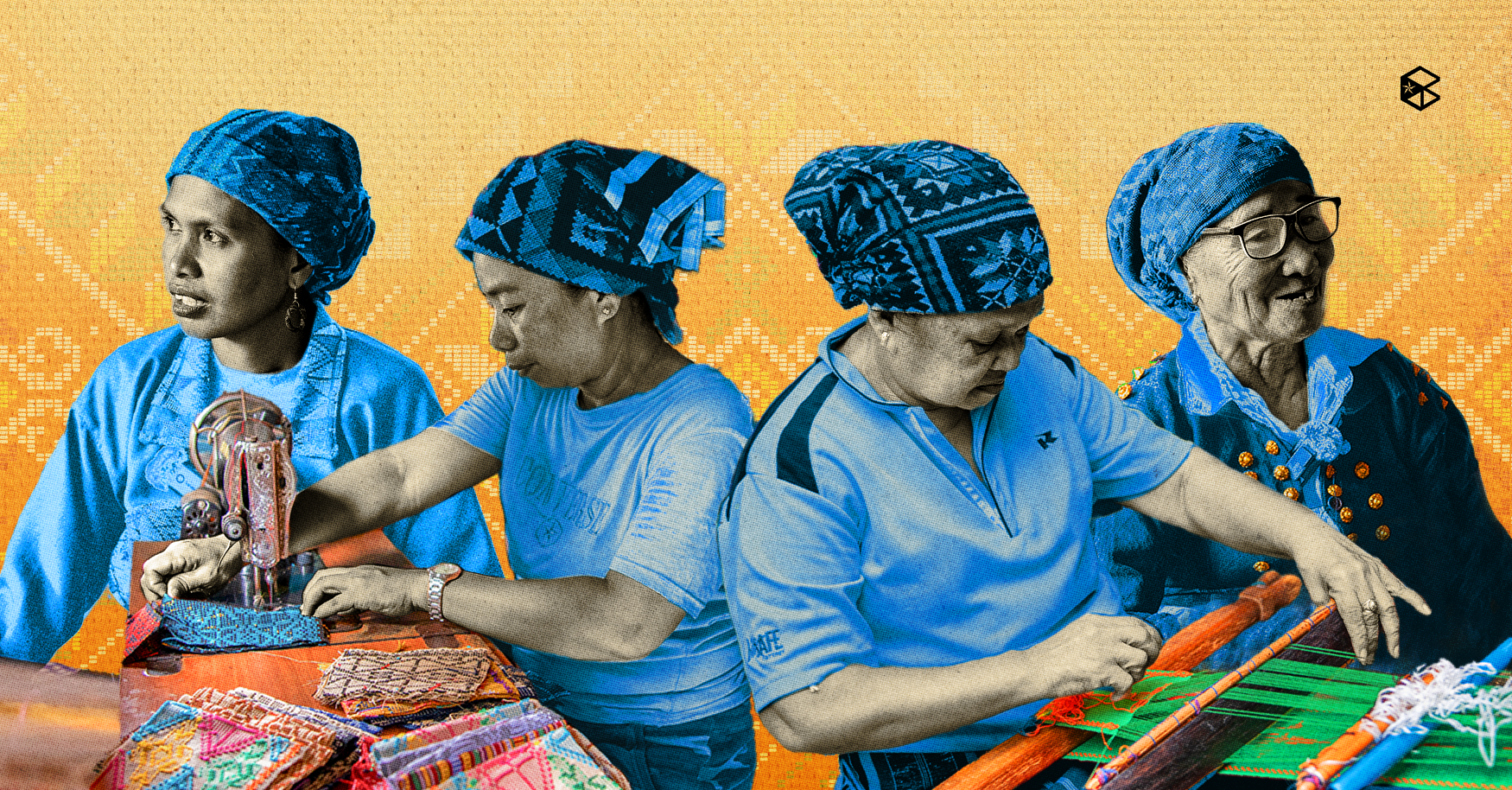




Before there were diamonds, zigzags, or other elaborate bands of color, there were only threads; fine strands stretched across a loom, carefully lined up before they became the vivid geometric patterns of Yakan weaving. The cloth, known as tennun, carries the rich cultural heritage of the Yakan people of Basilan, where the craft has long been woven into the fabric of everyday life.
Yakan textiles are distinguished by their bold colors and intricate geometric patterns. To create one, a female weaver sits on the floor with a belt called awit around their waist. Then, a warp beam (a cylindrical roller that holds yarn) is hung from a house beam in front of them. Their feet then brace against a block of wood called tindakan as they hold the threads taut. Before the cloth takes shape, they arrange the warp and pass its thread through a bamboo comb called a sud.
With each counting and grouping of individual threads, the strands fall into place, forming patterns that have long been part of the Yakan identity.
A history that refuses to unravel
Yakan weaving carries a long history enduring displacement and change. In the 1970s, conflicts between government forces and the Moro National Liberation Front (MNLF) drove many Yakan families out from their homeland in Basilan.
Having brought their weaving traditions to Zamboanga City, the craft found temporary refuge in the Yakan settlement in Upper Calarian. As the conflicts ended, weaving flourished once more in Basilan, providing Yakan women a source of livelihood and a way to keep their cultural heritage alive.
Each pattern carries meaning beyond their appearances. Designs often draw inspiration from the natural world and the Yakan people’s agricultural traditions, such as rice grain shapes symbolizing abundance and prosperity. Among the most intricate textiles are bunga-sama, sinelu'an, and seputangan, each with its own design intricately placed in a Yakan dress. What may look like a play of colors and shapes is—to the Yakan—a language of its own.
Woven in meaning
In the Yakan village in Zamboanga, weaving is a scene that has played out in homes for generations. And in Salma Ballati’s house, it now shares the front room with a shop.
Ballati is a master weaver and the link between three generations of women in her family who carry the craft forward. At 67 years old, she continues to weave and sell the cloth she has been making in her youth in Basilan, where her mother first taught her the craft. The skill passed down within the family, eventually becoming work she can do from home. Today, her house serves as both a place to weave and a shop where customers can browse through finished pieces.
But a textile does not come together in a single afternoon. Ballati explained in an exclusive interview with The Benildean that a piece made with a single color takes around four days to finish. More elaborate designs with multiple colors can take about five days. Each one requires the steady coordination of hands and looms since no machine can speed up the process. As Ballati put it, “Sa aming kamay talaga.”
Still, having pieces ready for sale does not mean that buyers will always come. Ballati’s business depends on tourists finding their way to her shop. “Pag may turista [at bumili], mayroon [kita]. ‘Pag wala[ng] turista, [wala] din,” she said. The hours spent weaving remain the same, whether or not someone comes through the door to appreciate the finished work.
Between the steady rhythm of the loom and the occasional arrival of a customer, Ballati carries on a craft that began with her mother, which now rests in her own hands.
Keeping the loom alive
Before dawn, the first sounds in a Yakan house are often the soft knock of the batten and the scrape of a bamboo shuttle. Ajura Ibrahim learned that beat at 10 years old when she would sit beside her aunt who showed her how to work the threads. Now that she’s 41 years old, she continues to practice and is passing down the craft to her children.
Ibrahim shared in an exclusive interview with The Benildean that weaving has changed over the years in ways outsiders might not notice. She described an older method which saw weavers using two shuttles. Today, they use four because a single piece takes too long when it’s worked one way.
“‘Yung dati po [na weaving], may pagbabago rin po [ngayon],” she said. Though their tools have changed, the work still remains in the hands of the weavers, because even a craft rooted in generations of practice must find ways to keep up with the time it takes to make a living.
For designs such as seputangan, which do not follow a fixed pattern, Ibrahim relies on memory and counting to bring each arrangement of colors together. She first imagines the design before beginning, as she said that a weaver must be in the right mood to work—anger and frustration can make it difficult to remember the sequence of threads.
Nowadays, the craft has grown alongside the people who practice it. Where woven textiles once took the form of table runners and traditional cloth, Yakan designs now appear on clothing, bags, wallets, caps, and other products that can reach a wider market. For Ibrahim, this growth has also meant having a shop of her own where she sells her and her Basilan relatives’ works directly to visitors.
Keeping Yakan weaving alive means spending days on a single piece, finding buyers for finished textiles, and learning to adapt a traditional craft to changing demands. But for Ballati and Ibrahim, preserving their heritage also means finding ways to make a living from it.
Weaving has endured displacement and the passage of time, with its future continuing to be shaped by the women who continue to practice it today. With each generation, new knots and choices become part of the craft, carrying forward what began in the hands of their elders and passing it on to those yet to come.
In the Yakan village, weaving never stopped—neither will the heritage that comes with it.
