
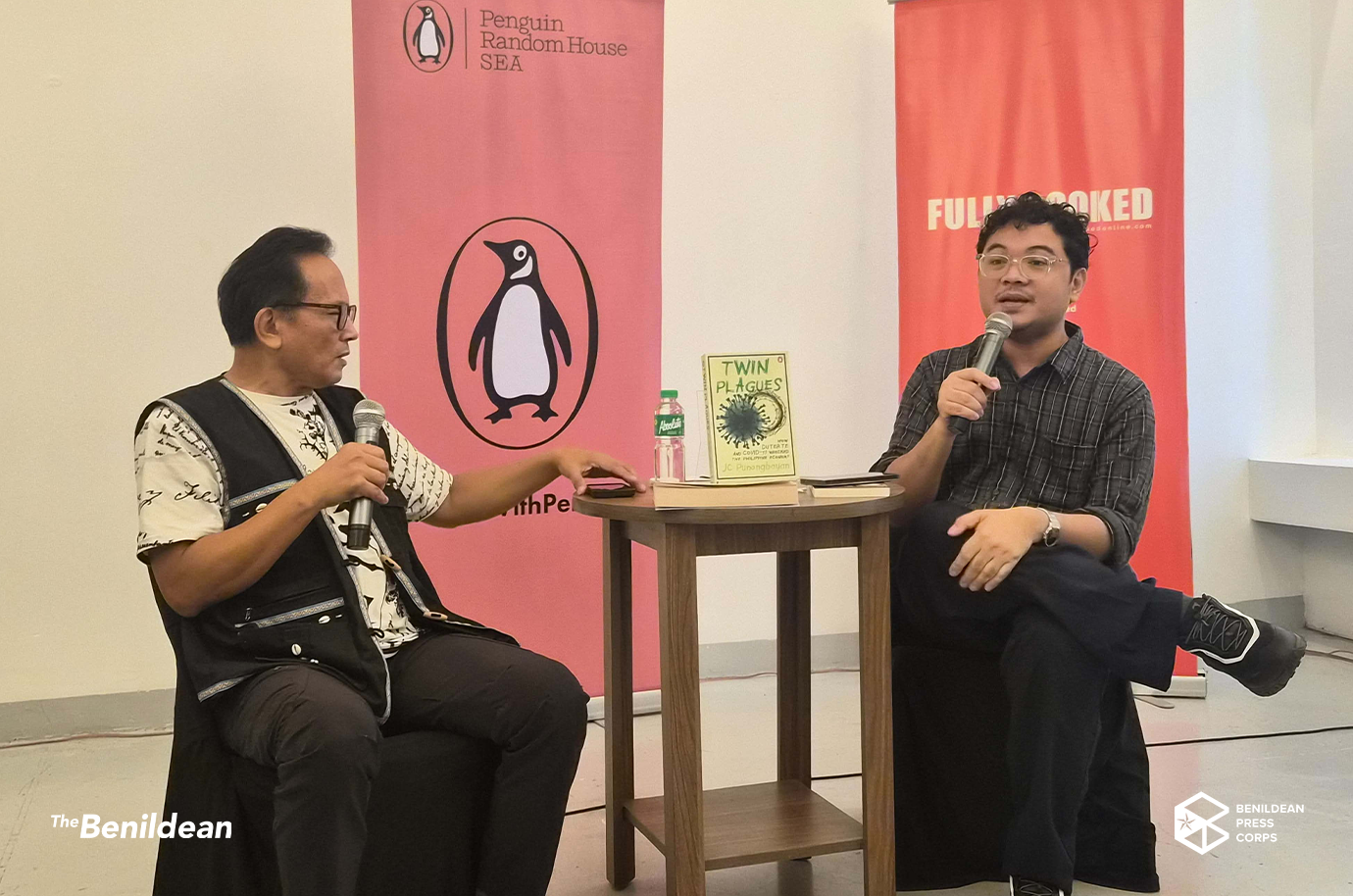




Jan Carlo “JC” Punongbayan’s second novel, Twin Plagues, took center stage on Oct. 11 at a book talk and signing organized by Penguin Random House SEA, in partnership with Fully Booked, exploring how weak governance, institutional erosion, and the pandemic left lasting scars on the Philippine economy, at The Studio, Fully Booked, Bonifacio Global City.
Journalist Howie Severino claimed that JC Punongbayan’s new book, Twin Plagues: How Duterte and COVID-19 Wrecked the Philippine Economy, was “a hard read.” Severino then questioned what motivated Punongbayan to write the book despite there being “little to no joy” in the novel.
In response, the economist highlighted the importance of remembering recent history: “Without proper documentation and examination, the country risks repeating the same mistakes.” This topic pointed to a larger mystery: Why do Filipinos continue to look so fondly on former president Rodrigo Duterte despite the evidence of economic and social costs of his administration?
Twin Plagues challenges the nostalgia during former president Duterte’s administration by exposing the disconnect between his public appeal and the costs of his leadership, documenting the consequences to counter romanticized narratives of his presidency.
Severino then commended the book’s conviction and research. However, he also asked the author how he intended to make a difference and penetrate new audiences. Considering its political subject matter, Severino commented that Twin Plagues is more likely to attract audiences who already share Punongbayan’s views, making it less likely for those with differing opinions to learn from it.
This conversation led to an enlightening discussion about how this predicament is further compounded by today's digital landscape, where social media platforms like TikTok and Instagram are constantly competing for attention, making it more challenging for books and long-form journalism to leave lasting impact.
In hopes of better governance and informed civic decisions
In an interview with The Benildean, Punongbayan emphasized the inseparability of economics and politics: “You can’t really separate economics and politics [...]. When you have good governance, then you can expect good economic outcomes, like economic growth, low inflation, et cetera. But when you have bad governance—like what we experienced during the pandemic—then it should be no surprise that economic outcomes were as bad as they were.”
Through his presentation and the broader arguments of Twin Plagues, Punongbayan reinforced a central point: political decisions shape economic policies and outcomes, while economic conditions, in turn, influence political decisions.
Reflecting on the crisis’ persisting consequences, Punongbayan shared: “We didn’t really need to have suffered such a deep economic crisis, one that really pulled our trajectory as a nation, and [...] condemned future generations to live with the wreckage.”
A better and hopeful future
The author does not merely dwell in retrospect. Looking forward, Punongbayan highlighted the role of the youth in civic participation: “[...] The impetus is for future generations—for the young Filipinos—to really make the best decisions possible in the upcoming elections because that would really set the trajectory of the country in decades to come.”
While the past and its consequences can no longer be undone, understanding them can help younger generations make more informed decisions in pursuit of better futures.
Missed JC Punongbayan’s book talk? No worries! Fully Booked regularly hosts book talks, author discussions, and other exciting literary events for readers to look forward to. Check out Fully Booked’s official Facebook page to stay updated on their upcoming literary events and collaborations.
