
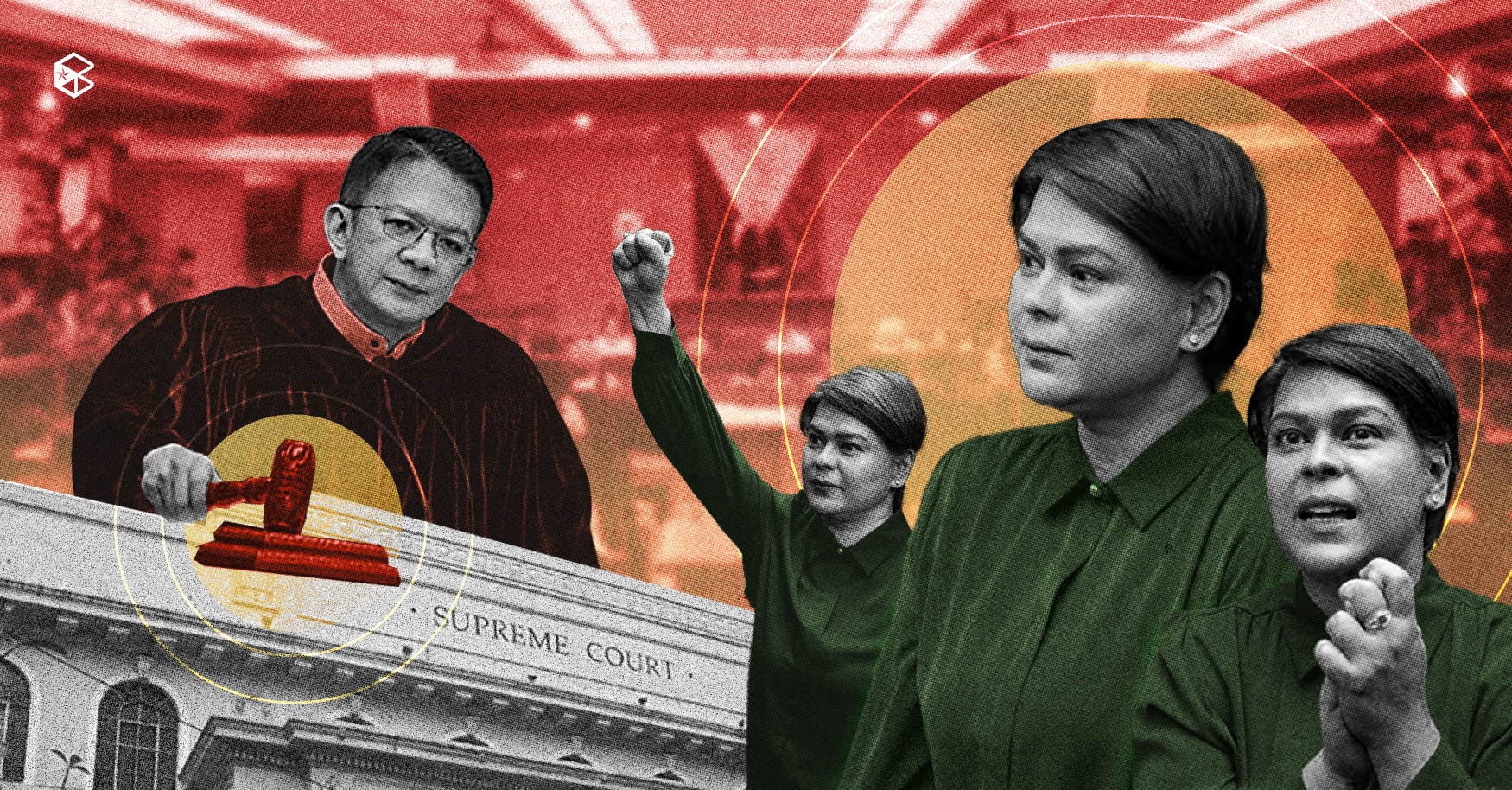




The Senate impeachment court on Oct. 13 accepted the House prosecution panel’s withdrawal of three of the four impeachment articles against VP Sara Duterte, leaving allegations of unexplained wealth as the sole basis for the remaining proceedings.
The decision narrowed the trial’s focus to Duterte’s assets, income declarations, and business interests. While withdrawing three articles may streamline the proceedings, it also limits public scrutiny by removing those allegations from adjudication in the impeachment court, raising questions about accountability and the prosecution’s strategy.
With the trial moving toward the defense’s presentation of evidence, the remaining case will depend on whether the prosecution can establish its allegations and secure the constitutionally required votes for conviction.
One article left
Presiding officer Senator Francis “Chiz” Escudero accepted the withdrawal of Article I on the alleged misuse of confidential funds, Article III on bribery, and Article IV on grave threats, including threats against President Ferdinand Marcos Jr., First Lady Liza Araneta-Marcos and former House Speaker Martin Romualdez.
House lead prosecutor Gerville Luistro said the panel would concentrate its case on Article II, which concerns unexplained wealth and described the withdrawal as “the most judicious course.” She also argued the move would spare the court from having to hear 32 additional witnesses who would no longer be called.
Under the Court’s ruling, Articles I and IV were withdrawn with prejudice and cannot be revived under the 20th Congress. On the other hand, Article III—which the prosecution had not supported with evidence presented in court—was withdrawn without prejudice. Thus, the court will no longer adjudicate the first and fourth articles, whereas the third was withdrawn on different procedural grounds.
What the remaining charge involves
Article II covers allegations of unexplained wealth, incomplete declarations in Duterte’s Statements of Assets, Liabilities and Net Worth (SALNs), and failure to divest prohibited business interests.
On Oct. 12, forensic accounting expert Alexander Cabrera presented a report during a cross-examination by defense counsel Kristine Ferrer, identifying approximately ₱817.87 million in alleged unexplained wealth involving Duterte and her husband, lawyer Manases Carpio, from 2022 to 2025.
During subsequent questioning, Cabrera also discussed a possible estimate of ₱1.5 billion under a broader assessment that included additional financial discrepancies and assets excluded from his original computation. He clarified that the higher figure was a possible estimate, not a revised final finding, and remained subject to deductions for applicable liabilities and taxes.
These figures represent the prosecution expert’s assessment, not a judicial finding of guilt. The impeachment court must evaluate the underlying financial records, the attribution of assets and income, and whether the alleged omissions and business interests establish grounds for impeachment under the Constitution.
Duterte, meanwhile, argued that the withdrawal of the bribery article supported her longstanding position that the accusations against her lacked evidence. “‘Yung pag-drop ng bribery charge sa impeachment, ito 'yung sinasabi namin sa simula pa lang [...] walang ebidensiya lahat ng kanilang akusasyon,” she told reporters on Oct. 13.
Her remarks concern the withdrawn bribery charge and her defense against impeachment. They do not resolve the allegations that remain before the court.
The defense’s response
The withdrawal also created a procedural concern for the defense: prosecutors had already presented evidence on two of the three withdrawn articles, but Duterte would no longer be able to answer those charges through evidence presented in the impeachment trial.
Lead defense counsel Sheila Sison objected to the prosecution’s withdrawal of accusations after presenting evidence against her client. “The prosecution cannot be allowed to have the benefit of its accusations without bearing the burden of having those accusations tested,” she stated.
The court limited the defense’s presentation of evidence to Article II but lifted the sub judice restriction, allowing both parties to publicly discuss and respond to allegations under the three withdrawn articles. However, separate confidentiality rules for protected information remain in effect.
Duterte may publicly answer allegations that will no longer be tried, but she cannot present defense evidence on those withdrawn articles as part of the remaining impeachment proceedings.
The constitutional stakes
Under Article XI of the 1987 Philippine Constitution, the Senate has the sole power to try impeachment cases, with conviction requiring a two-thirds vote. On Sept. 23, the impeachment court voted to lower the conviction threshold from 16 to 14 votes. Six senator-judges—Alan Peter and Pia Cayetano, Christopher “Bong” Go, Imee Marcos, Robin Padilla, and Camille Villar—abstained from voting.
Likewise, Senator Loren Legarda was on medical leave, while Ronald “Bato” dela Rosa was absent amid an International Criminal Court (ICC) arrest warrant. Whereas, Rodante Marcoleta and Jinggoy Estrada were detained in connection with plunder cases.
The narrower case reduces the number of allegations the Senate must adjudicate, while increasing the importance of the financial evidence presented under Article II. The prosecution must establish the basis for its claims through admissible evidence; its estimates alone do not determine the outcome.
Likewise, withdrawing three articles does not establish that Duterte is guilty or innocent of the remaining allegations. The court’s decision therefore leaves the central question unresolved: whether the prosecution’s evidence on unexplained wealth and related financial disclosures is sufficient to warrant conviction under the constitutional standard.
The Senate impeachment court is scheduled to resume proceedings on Nov. 9, where Duterte’s defense will begin presenting evidence following the Senate’s recess and budget deliberations. Escudero likewise set trial dates from Nov. 10 to 13, Nov. 19 to 20, and Nov. 23, subject to plenary sessions and other scheduled activities.
The next stage will test the prosecution’s allegations against the defense’s response, with the possibility of a motion for reconsideration still looming. With three articles withdrawn, it may have narrowed the trial, but it has not diminished the questions of accountability at its center.
The Senate now faces the task of weighing evidence against the constitutional standard for conviction; a test of whether the country’s highest officials can be held to account through a process grounded in evidence, fairness and the rule of law.
The proceedings remain ongoing, with further updates to follow as the Senate impeachment court resumes hearings.
