
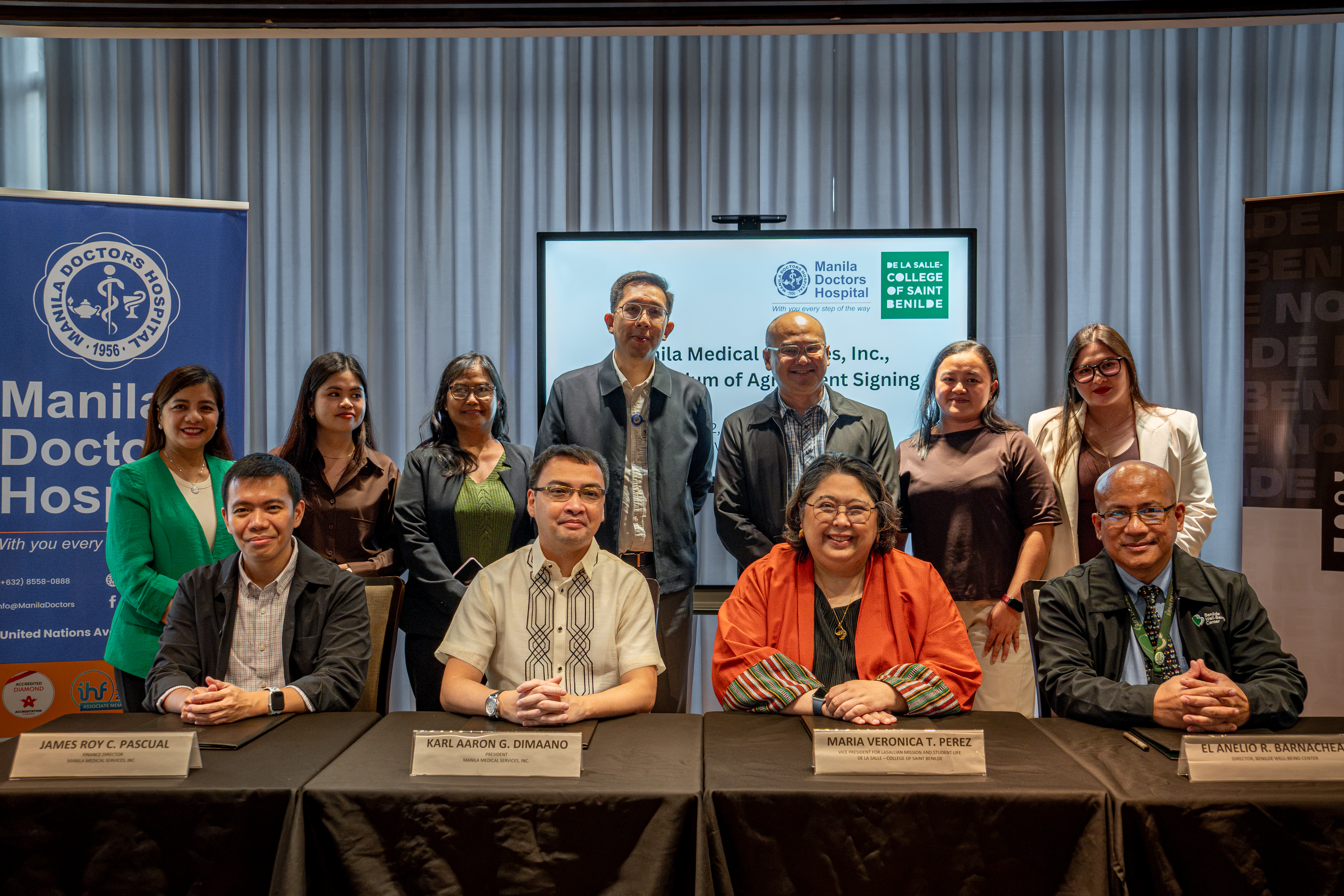




The De La Salle-College of Saint Benilde (DLS-CSB) signed a Memorandum of Understanding (MOU) with Makati Medical Center (MMC) and a Memorandum of Agreement (MOA) with Manila Doctors Hospital (MDH) to expand Benilde Well-being Center’s (BWC) mental health services on Sept. 22, at 4/F Keyland Building, Makati Medical Center and the Vatel Restaurant, Atrium Campus, respectively.
In these agreements, DLS-CSB was represented by Vice President for the Lasallian Mission and Student Life Ms. Nicky Templo Perez and Director for BWC Mr. El Anelio Barnachea.
DLS-CSB first secured its MOU with MMC, establishing access to professional evaluations, consultations, and interventions by relevant specialists through a referral process such as developmental behavioral physicians, psychiatrists, and psychologists.
Acting for the MMC, the MOU was signed by Senior Vice President and Division Head for Creative, Communications, and Sales Services Ms. Arlyn Songco and Department Manager for Sales Services Ms. Mary Ann B. Lee.
Upon signing, Ms. Perez and Ms. Songco expressed messages of support to extend gratitude, vouch for the partnership’s needs, and uphold their commitment to the cause.
“What a relief [it is] to have one of the best premier hospitals in the Philippines [to] be the one to come to us [...] for the sake of our students, the youth, our future, the nation's future, and also for the adults who take care of them in the community,” Ms. Perez shared amid the prevalent mental health concerns of the college’s students and associates.
Ms. Songco then commended the people and institutions obtaining mental health services, reminding that “it's a great leap towards a more holistic approach to the well-being of your students.” She added how the assessment of one’s mental health “is [a] strong foundation into how they manage themselves, their thoughts, [and] their actions.”
Later on the day, the MOA with MDH was formalized through the signatures of its representatives: Manila Medical Services, Inc., President Karl Aaron G. Dimaano and Finance Director James Roy C. Pascual.
Like the previous memorandum, the MOA legally recognizes MDH as a referral partner for students and associates requiring professional mental health care, such as counseling and medical treatment.
During his address on the organization’s behalf, Mr. Dimaano highlighted the importance of having a “safe structure that allows the youth to access early intervention, professional care, and a strong system support” amid present-day issues driven by social media, the growing mental health crisis, and recent incidents of campus violence.
In an interview with The Benildean, MDH Head of Medical Services Division Dr. Giovanni G. Dangca, MD shared that the partnership between both entities is essential as these institutions share a responsibility in supporting the growth and well-being of the youth.
“Lately, of course, we saw sad news of a lot of violence that involves schools, and this stems down to the psychological and mental preparedness of our students. Especially if [...] we are not too careful. All of us are accountable—parents, teachers, not only the students.”
As the parties carry out their respective services, they must also ensure that assessment and treatment decisions remain independent.
Ms. Perez clarified that “not all students who are in [psychological distress] feel the need for help academically; [these are] two separate requests. The request for academic support [only] happens through the school. [...] In the same way, Benilde will not have access to whatever relationship a student will have with one of the psychologists or psychiatrists that [they] may meet.”
Aside from balancing the parties’ responsibilities, Ms. Perez anticipated a surge in referrals during midterms, finals, and grade-release periods, similar to the trends experienced by college counselors.
Dr. Dangca noted three more prospective challenges in the implementation: great disproportion between the practitioners and patients, seeking sufficient facilities and providers; accessibility and affordability of therapy sessions; and the deep-seated cultural stigma surrounding psychologist and psychiatrist consultation.
Despite this, he expressed high hopes that the collaboration will encourage acceptance and will open opportunities for those who seek mental health support services.
Ms. Perez reaffirmed that “the sooner [a student seeks help], the earlier [...] we're able to provide intervention. [It] is actually better for the student [...] It will surely stabilize them throughout their stay in College and prepare them for the real world.”
Dr. Dangca expressed to the Benildean community the value of having a reliable support system—such as family, friends, and faith—when faced with uncertainty, doubt, and stress, instead of harmful coping mechanisms, citing the excessive dependence on Artificial Intelligence (AI).
To conclude, Dr. Dangca advised students to reach out to the healthcare professionals first, emphasizing the importance of their specialized training and evidence-based, data-driven expertise. He encouraged students not to bear their struggles alone, but to reach out to professionals equipped to provide safe and informed support.
