
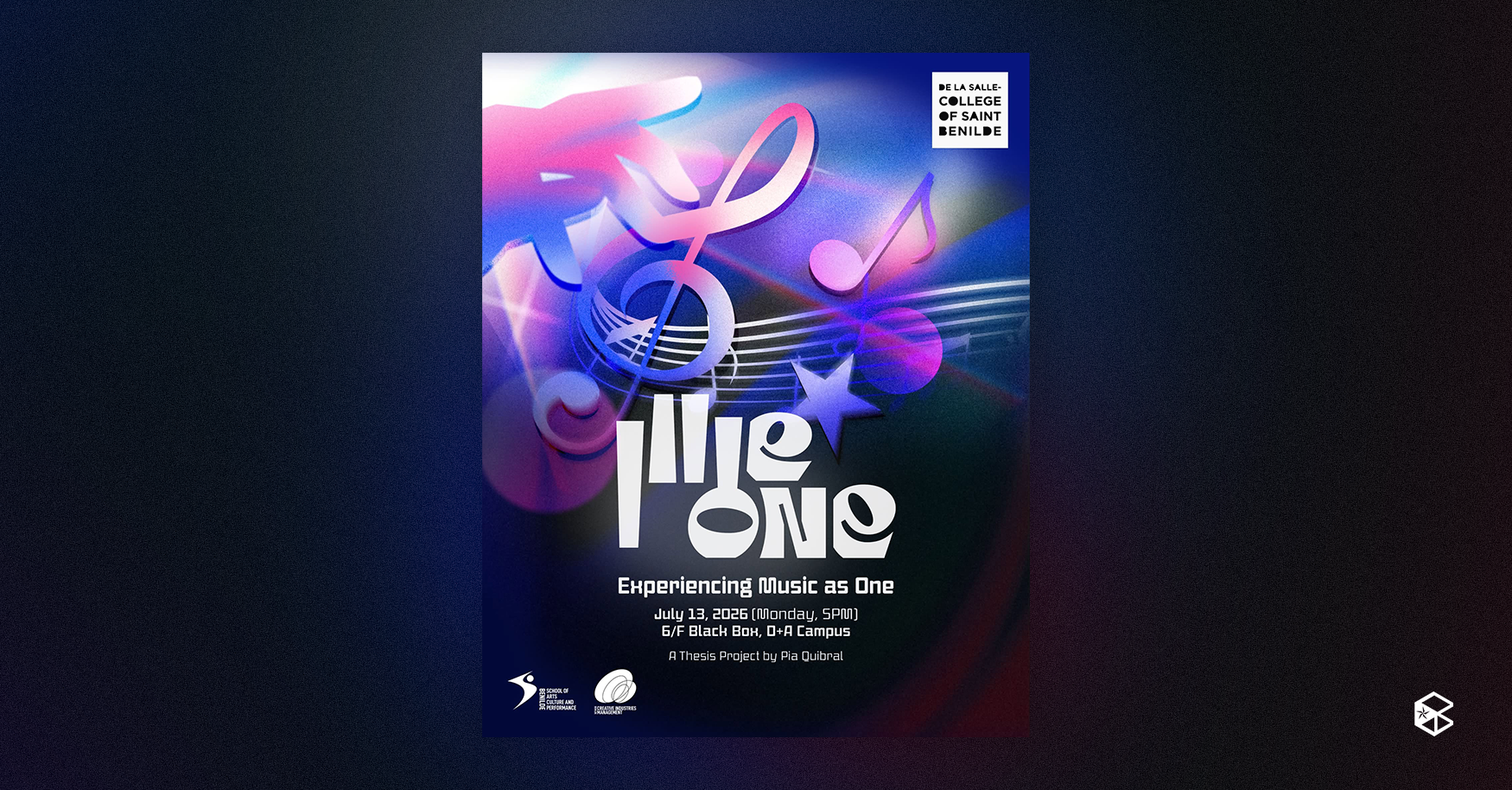




BeONE: Experiencing Music As One transformed the 6/F Black Box Theater of De La Salle-College of Saint Benilde’s Design and Arts (D+A) Campus into a shared space for Deaf and hearing audiences on July 13. Produced by ID123 Creatives Industries Management (ABCIM) student Pia Quibral as her undergraduate thesis, the one-night concert explored how live music can extend beyond sound through movement, visual storytelling, and Filipino Sign Language (FSL).
The program opened with a recorded message from thesis adviser Mr. Alain Zedrick Camiling, who described BeONE as a project that challenged conventional ideas of what a concert could be. Rather than treating accessibility as mere accommodation, he emphasized that meaningful experiences begin with spaces intentionally designed for everyone to participate.
Throughout the evening, the concert brought together performances from DJ Eros, De La Salle Senior High School’s AniMove, the University of Santo Tomas’ UST PRIME, IMPULSE—La Salle Dance Company’s official alumni street dance group—and Benilde-based band Uncle Jonny.
The experience also left an impression on the performers themselves. Members of Uncle Jonny reflected on what made BeONE different from their previous performances. “We were really excited because this was our first time performing in an event that catered to both Deaf and hearing audiences. It challenged us to think beyond playing our music—we wanted to make sure everyone could feel and enjoy the experience together.”
Beyond sound
While each act showcased a unique performance style, they shared a common approach to accessibility through sign language interpretation, expressive movement, and synchronized vibrations that allowed Deaf audiences to experience the rhythm alongside hearing attendees. Audience seating was likewise thoughtfully arranged to provide Deaf guests with a clear view of the interpreters while maintaining a shared concert environment.
In an exclusive interview with The Benildean, Kristian Lungay, an ID123 ABCIM student, one of the night’s highlights was when performers incorporated sign language into their routines. “They really put [their] care not just into the project’s development, but also into the artistry,” he shared, adding that the event offered a new perspective on how live performances can become more accessible and inclusive for persons with disabilities.
Designed with inclusion in mind
In her closing remarks, Quibral shared that the inspiration behind BeONE stemmed from her encounters with members of the Deaf community through FSL classes. Hearing their experiences with live concerts led her to ask a simple question: “How can they enjoy concerts as much as I do?” That question ultimately became the foundation of her thesis project.
Reflecting on the production, she also shared in an interview with The Benildean that assembling the team relied largely on the support of friends, collaborators, and connections who believed in the project’s vision. Her closing remarks turned deeply personal as she thanked the people who stood beside her throughout the project. She became emotional while recalling the moments she questioned whether BeONE would ever come to life. Despite moments of uncertainty, she shared that their encouragement ultimately gave her the confidence to see the project through.
One experience, one audience
For Hans Sioson, an ID123 student from the Applied Deaf Studies (BAPDST) program, the experience exceeded their expectations. The incorporation of sign language by performers, energetic interpreters, and vibrotactile flooring, created an environment where music became “incredibly open, alive, and immersive.” They added in an interview with The Benildean that the event demonstrated how music could be recognized and experienced through more than hearing alone.
Inclusion remained at the heart of the experience for Sioson, stating that “Music belongs to everyone.” He described BeONE as “absolutely powerful because it celebrates inclusivity.” They added that the incorporation of FSL into the performances and the use of vibrotactile flooring allowed Deaf audiences to completely immerse themselves in the music alongside everyone else. “I see these respectful interactions, representation, and innovative technology that makes me deeply appreciate being seen with our Deaf community and to foster empathy where everyone belongs,” he shared.
As the evening came to a close, Quibral expressed her hope that BeONE would become more than a thesis requirement. Instead, she envisioned it as the beginning of larger conversations on accessibility in live events—not only for the Deaf community, but for everyone. In many ways, BeONE fulfilled the promise that it carried. By bringing Deaf and hearing audiences into one shared space, the concert demonstrated that music is not defined solely by what can be heard, but by the experiences people create together.
Learn more about upcoming performances, exhibitions, and creative initiatives by following Benilde School of Arts, Culture, and Performance (SACP) on Facebook and Instagram!
