
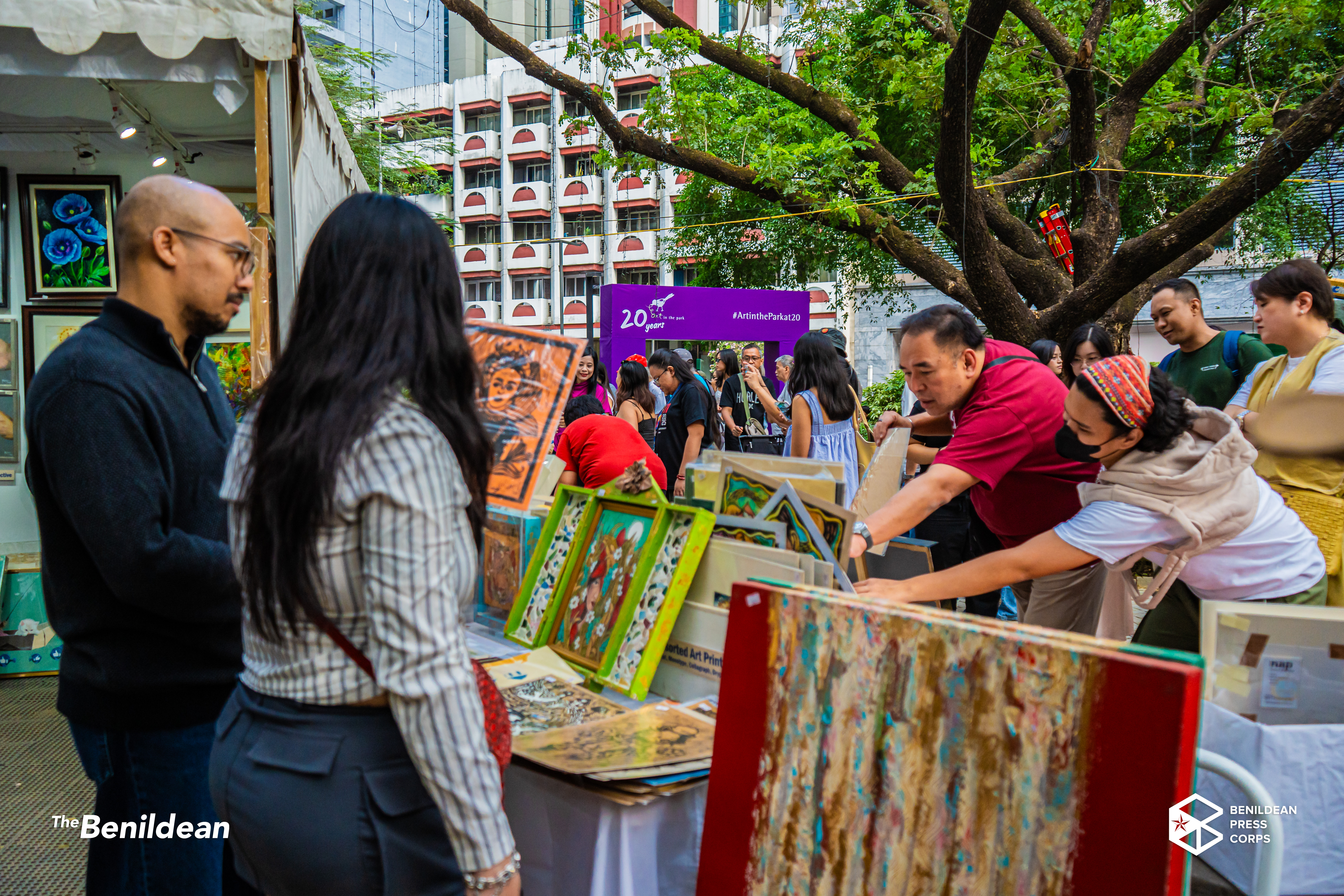




Art in the Park ushered in its 20th edition on March 15 at the Jaime Velazquez Park in Salcedo Village, Makati City. Free and open to the public, the fair brought together over 60 exhibitors, bringing galleries, collectives, independent spaces, and student groups together for a sun-to-evening showcase of Filipino creativity.
Among this year’s exhibitors was a booth from De La Salle-College of Saint Benilde spearheaded by the College’s Creative Industries Management (AB-CIM) program—bringing the School’s signature creativity to the park alongside the Philippines’ most exciting artists and art communities.
Organized by Philippine Art Events, Inc., the fair continues to benefit the Museum Foundation of the Philippines in support of the National Museum of the Philippines.
The park is the canvas
What set Art in the Park apart from the white-walled formality of larger fairs is its texture—the grass underfoot, the mix of families and first-time collectors, the teenager eyeing a print for their bedroom wall. Artworks were capped at ₱70,000, though many pieces went for less, a deliberate move that keeps the fair grounded in accessibility.
For Arts Management (AB-AM) alumna Andra Alcazar, that openness is exactly what keeps her coming back. “There's little to no barriers to entry, everybody can come in. People don't need to buy art. They can just be here to appreciate it,” she shared.
Ms. Alcazar, who has been leading the management side of the Benilde Booth since 2023, sees the fair as a launchpad for many. “A lot of artists have been discovered in Art in the Park because a collective gave them a chance to showcase their work," she added. This spirit of discovery runs through the entire fair, where many artists, regardless of gallery representation or financial backing, stood shoulder to shoulder with already established names, as proof that for one Sunday a year, the park belongs to everyone.
A unique kind of weekend outing
Salcedo has always been known for attracting an eclectic community. Even among a crowd as unique as the attendees of the event, the exhibitions were just as manifold. Multiple established art galleries displayed the full breadth of their works from oil paintings, to toys, and even dinnerware. DLS-CSB presented works from the Benildean community. According to Miggy, an eventgoer, even the anonymous artist behind the famous “Why?” graffiti seen across Metro Manila was in attendance at the event.
An artist from Gallerie Stephanie, Cello Dolls, told The Benildean that she felt a stronger sense of community between artists at the Art in the Park compared to other art events she’d previously visited or exhibited at. She attributed this sense of community to the event’s green setting, as opposed to the typical indoor galleries.
Ms. Dolls feels the event did away with the inherent intimidation of a typical art gallery—no white walls demanding silent visitors, and no obligation to buy.
Breaking the barrier between people and art
Art in the Park’s accessibility to all individuals interested in the arts manifests in the absence of any paywall since its inception in 2006. Another attendee, Timy Santos, shared that they felt the lack of an entrance fee was a breath of fresh air. “The idea that it’s free is freeing,” they said.
Art in the Park’s ease of access played a significant role in the event’s popularity—a popularity which created opportunities for many exhibitors. Ms. Dolls shared that art events should be given more importance in the current climate of AI-generated content, especially since events make people confront and engage directly with art instead of passively consuming it through social media. Wynette Herman, another student of the AB-CIM program, said they were happy to get eyes on the College’s art pieces, and to demonstrate to the art world what makes the College’s community like no other.
Art in the Park—even after two whole decades after its founding—finds relevancy to the current time. By providing a more relaxed and accessible environment, the event centered on and promoted a far more personable and direct engagement with Filipino art.
Amidst rising prices for both audiences and artists, as well as the seemingly endless torrent of AI-generated art on social media, the exhibitions remind us that experiencing art is something for every Filipino, not just the few who can afford it.
