
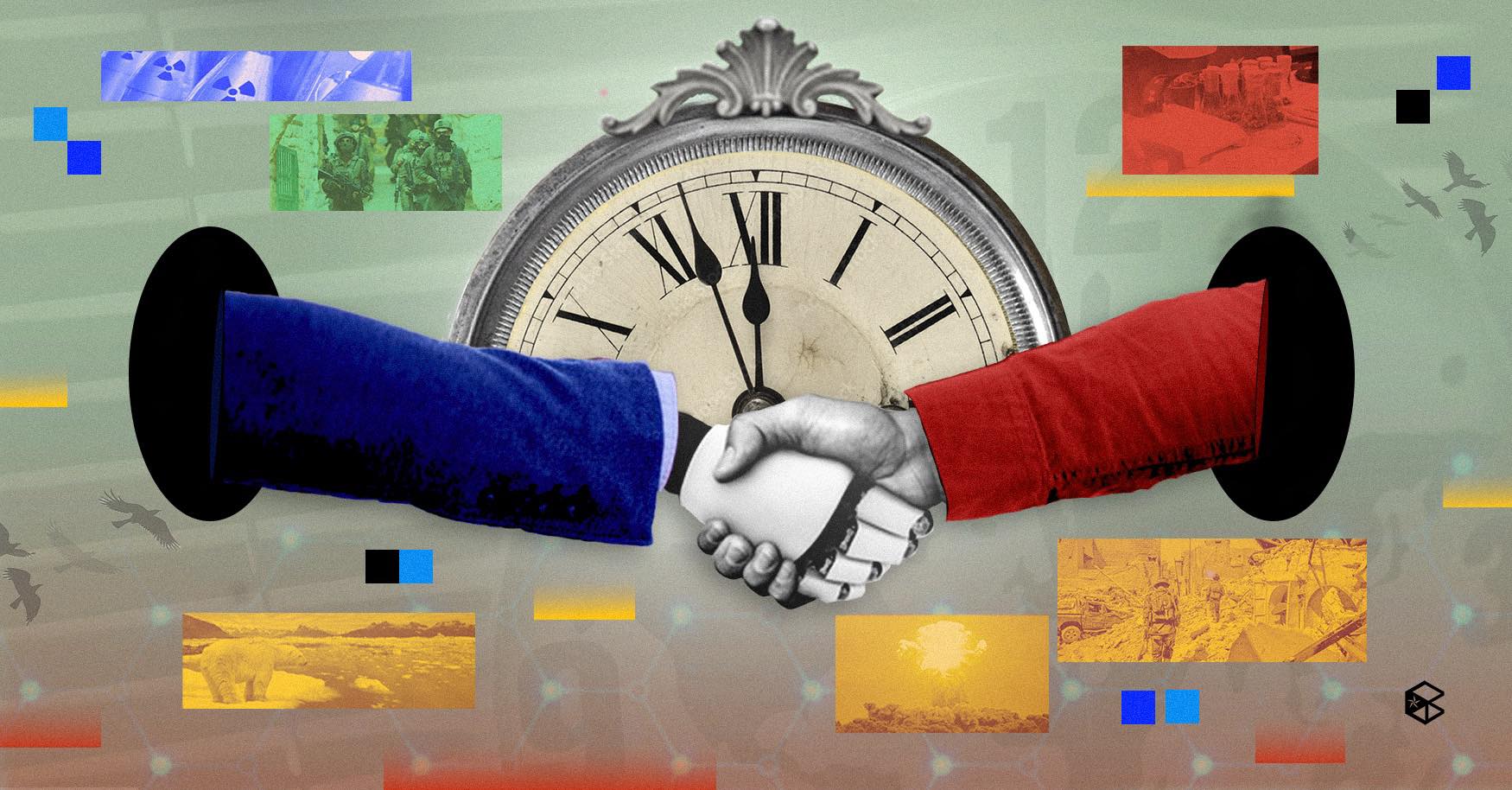




The “Doomsday Clock,” a metaphorical timepiece for how close humanity is to self-destruction, has ticked 85 seconds closer to midnight—the closest point to catastrophe in its history of creation nearly 80 years ago.
The Bulletin of the Atomic Scientists, a non-profit organization concerning science and global security issues, warned in its annual assessment on Jan. 27 of the growing risks of humanity, including nuclear weapons, climate change, and disruptive technologies such as artificial intelligence (AI).
"Every second counts, and we are running out of time," Alexandra Bell, president and CEO of the Bulletin of the Atomic Scientists, said in her speech during the announcement ceremony on Jan. 27.
The Doomsday Clock was first conceptualized in 1947 during the nuclear arms race between the United States (U.S.) and the Soviet Union by artist Martyl Langsdorf when the co-editor of the Bulletin of the Atomic Scientists, Hyman Goldsmith, asked her to create a cover for their June 1947 magazine issue.
Langsdorf sketched a clock to emphasize the time constraints for controlling nuclear arms. The clock was originally set to seven minutes simply because “it looked good to her eye.” Since its creation, it has measured how well societies worldwide deal with its surrounding technological and sociopolitical circumstances.
Scientists set new time
This 2026 sets the record for the closest the clock has ever been to midnight since it was established in 1947, with Bell further emphasizing that “humanity had not made sufficient progress” against existential threats from her same speech.
The Bulletin’s Science and Security Board, in consultation with its Board of Sponsors, sets the Doomsday Clock on an annual basis and based it on conditions involving nuclear weapons, emerging technologies, climate change’s effects, political conflicts, and how urgent global efforts combat these issues.
This year, the Bulletin assessed the lack of international cooperation in nuclear weapons, climate change, and biotechnology, and the arising threats of AI to move the clock forward. Daniel Holtz, chair of the Bulletin of the Atomic Scientists, also named nationalistic autocratic governments, or governments with one or few people having absolute power (autocracy) that prioritizes the nation’s interests and allegiances (nationalism), as a threat in the announcement ceremony’s official video.
Extending handshakes, extending clock hands
While this year is the most critical, 1991 marked the farthest the clock hands moved away from midnight was during the end of the Cold War in 1991, from the initial setting of seven minutes to 17 minutes based on the Bulletin’s Frequently Asked Questions article on the Doomsday Clock. SJ Beard from BBC cites the agreement between the U.S. and Russia on 1991 Strategic Arms Reduction Treaty (START), which aimed to remove about 80% of nuclear weapons, as its defining moment.
Before the extension of 17 minutes in 1991, three minutes was once a precarious time in 1984 as dialogue between the Soviet Union and the U.S. had stopped as mentioned by Lyndal Rowlands from Al Jazeera. Three years later, the 1987 Intermediate-Range Nuclear Forces Treaty was signed, banning their ballistic missiles and phasing out over 2,600 nuclear missiles—an evident response and policy impact from the clock noted again by Beard.
Global leaders called it a minute
In a statement from an article released by the Bulletin of Atomic Scientists’ Science and Security Board, the editor of the Bulletin of the Atomic Scientists, John Mecklin, said major countries like Russia, China, and the U.S. had been more indifferent and dominance-oriented, compromising hard-won global understandings and international cooperation by implementing respective policies that exacerbate existential risks.
The Bulletin referenced instances of weapons and regional conflicts’ developments for nuclear threats, global warming for environmental threats, and potential disruption of ecological integrity for biotechnological threats to move the clock forward in the following events over the past year.
The long-running major regional conflicts between Russia-Ukraine, India-Pakistan, and Israel-U.S. with Iran have started escalating last year, heightening global nuclear tensions. The U.S. also foresees deploying Golden Dome, a new missile defense system with space-based interceptors, raising the risk of space-based arm race and conflict, while the New START is set to expire on Feb. 5 according to the Vienna Center for Disarmament and Non-Proliferation.
With the wars aside, the past three UN summits left fossil fuel phase-outs unaddressed and the U.S. administration declared war on renewable energy. Last year’s atmospheric carbon dioxide emissions and global temperature matched 2024’s record-breaking statistics of being the warmest year with emissions 150% above pre-industrial levels.
Concurrently, scientists from nine countries warned that the laboratory synthesis of “mirror life,” or organisms made of chemically mirrored molecules in December 2024, and advances in AI raised concerns about designing new pathogens that could evade human defenses, yet no international plan exists to manage them.
The role of the Doomsday Clock
Mecklin recommended ongoing bilateral and multilateral discussions between the U.S. and Russia on nuclear arsenals and testing and among the U.S., Russia, and China to establish guidelines for integrating AI into military nuclear command. He also encouraged the U.S. Congress to retract the war declaration on renewable energy and the international community to address biological threats posed by AI.
There is no single solution to these global challenges but experts reassure that the problem is solvable and change is possible. The Bulletin states that its cause began with humans and the responsibility lies within the collective consciousness to reduce these threats.
The Clock’s setting is not an inevitable path to total annihilation; its purpose is to reinforce global cooperation as public engagement pressures leaders to act—with education as the best channel to ensure action.
Though these catastrophic risks are systemic in nature that escalated throughout decades, individuals should not underestimate the public’s ability to demand change, as sparking conversations influence strategies, policies, institutions, and power.
