
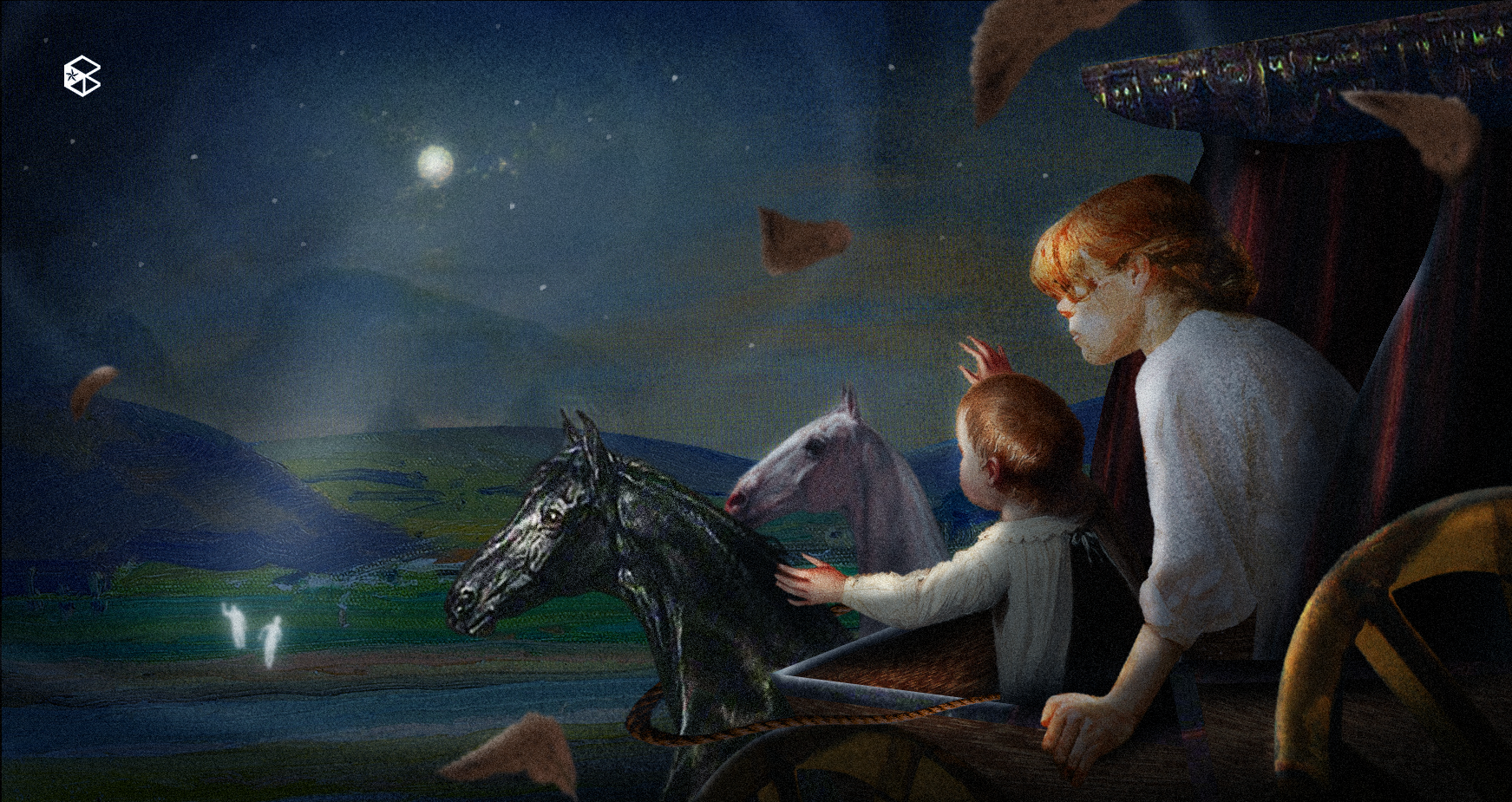




Midnight grazed the foliage that thickened northeast into the forest. January winds brought leaves into the otherwise warm savanna. It was what Paul’s family called “the month of the snow,” and their large wooden carriage creaked and shrank under the cold.
“Is Midnight eating anything because of how hungry he is?” Paul asked his mother, Marcela. Her upper half was inside the canvas drapes, tucking her younger children to sleep. Sunrise, their other native racehorse, was asleep at Paul’s feet.
“If anything, this is a feast to them.”
Paul looked at how Midnight’s raven-black coat shone in the moonlight. He had a memory of seeing his father, whose name he shared, coming through the open gates on horseback with his godfather. They would go halfway around their fountain path, and into the stables. His chest ached, and he exhaled. “Mama, I’m hungry.”
“In the morning, Paeng will come.” Paeng was the family’s boy.
“It is the morning.”
“Don’t be smart with me,” Marcela was relieved to bite back. She found being consoling in a situation as unique as theirs very disconcerting and unlike herself. She longed to let the wind answer her. She had a memory of Bien’s shame that had not occurred to her would be the last day she would see him.
Bien was her eldest son’s godfather, her husband’s best friend. He had come to donate a large batch of feed for the horses. Marcela thought it unusual yet sweet and eventually came to realize was his sorry, laughably lacking compensation for implicating an old friend.
She watched the men in uniform, who pillared the streets all day, come into their drawing room. The Colonel calmly commanded Paul I, who was making a mango turtle, to appear before the General the morning of the next day. Marcela looked at her husband. The children were playing in the orchard. The carriage was not ready.
Paul shifted on the front boot to face his mother, who had now emerged from the canvas, brushing her short hair. He brought his voice down and tightened his throat in an attempt to sound cute. “Will you finally tell me what happened to Papa?”
Marcela, who quit her elementary teaching job for this exact reason of despising children’s inquisitive nature, was cursed with the talent of communicating with them and answering their questions. This resentment was, but an unrealized fear and a desperation for control, as it seemed children were so curious about a world that only sought to turn compounds into carriages, fountain paths into foliage, living into hiding and waiting. She came into a squat, swiping away at the dust and thin splinters on the skirt of her button-down dress. “Okay. Let’s start with what you think happened.”
“The police are mad at him because of what he writes?” Excited Paul searched his mother’s vacant eyes.
“Don’t ask me. Go on.” She could not deny that she enjoyed this semblance of normalcy. It was as if she were in the study with her little boy, poring together over homework under the focused light of a lamp. This time, it was the silver moon, and the homework was the grassland before them, far away from the next town and even farther away from home, asking where Paul I was. And when he was coming back.
“He is hiding?” He found a spark in the brown orbs of Marcela’s skull. Confirm it, Mama. Deny it, Mama.
She smiled a gummy smile, a contagious one, not by nature. But because her joy permitted everyone else’s, and her sorrow or fury banned it. She did not confirm nor deny, but relayed the question to the new year’s breeze. “He is hiding?” She laughed. The moon and stars hung from a low ceiling—the bright darkness was a roof above their heads. The grass and the bark of shedding trees drank up the silver sky and became reflectors. Marcela looked at Midnight coming to a rest next to Sunrise and asked the racehorse, “He is hiding, Midnight?”
Paul corrected his tiny smile.
Marcela corrected her sinister tone. “You are smart, Paul,” she sighed, the pressure in her mouth releasing a cloud of vapor from her lips. “Just like Papa. He is finding his way here like we agreed.”
Paul nodded, making sure to keep a mental record of that sentence. Finding his way here like we agreed. He filed the recording in an organizer on a shelf in a study, but his chest ached for his mother. He was smart indeed and knew his questions only echoed the ones she stopped herself from asking. He was a lot like her in a way that was often unsaid. “You are also smart. And you are strong and honest.”
She smiled a gummy smile, a real one that permitted a true beam from her eldest son. Sunrise stirred. They looked at him lovingly. “Is he dreaming?”
To be asked a question by Marcela was like a reward, a letting in. Paul wanted to say something brilliant, but decided to go with feeling instead. “I think he knows Midnight is falling asleep.”
Marcela made sure to keep a mental record of that sentence. I think he knows. She filed it in an organizer on a shelf in a study, where she could hear someone Finding his way here like we agreed. She turned her head and found, in the lilac distance, Paeng approaching on his horse. Relief washed over her like the velvet dawn did over the savanna, pulling the blanket of night higher and higher.
Sunrise arose and whickered, shaking his head. Paul and Marcela examined the extra load that seemed to bulge from behind the faraway Paeng.
Then a hand waved, and it occurred to them.
Paul I peeked his head from behind the honorable Paeng, a smile of relief under a wide-brimmed hat. Paul II jumped inside the carriage and shook his little siblings awake.
“He’s here! He’s here! He’s here!”
