
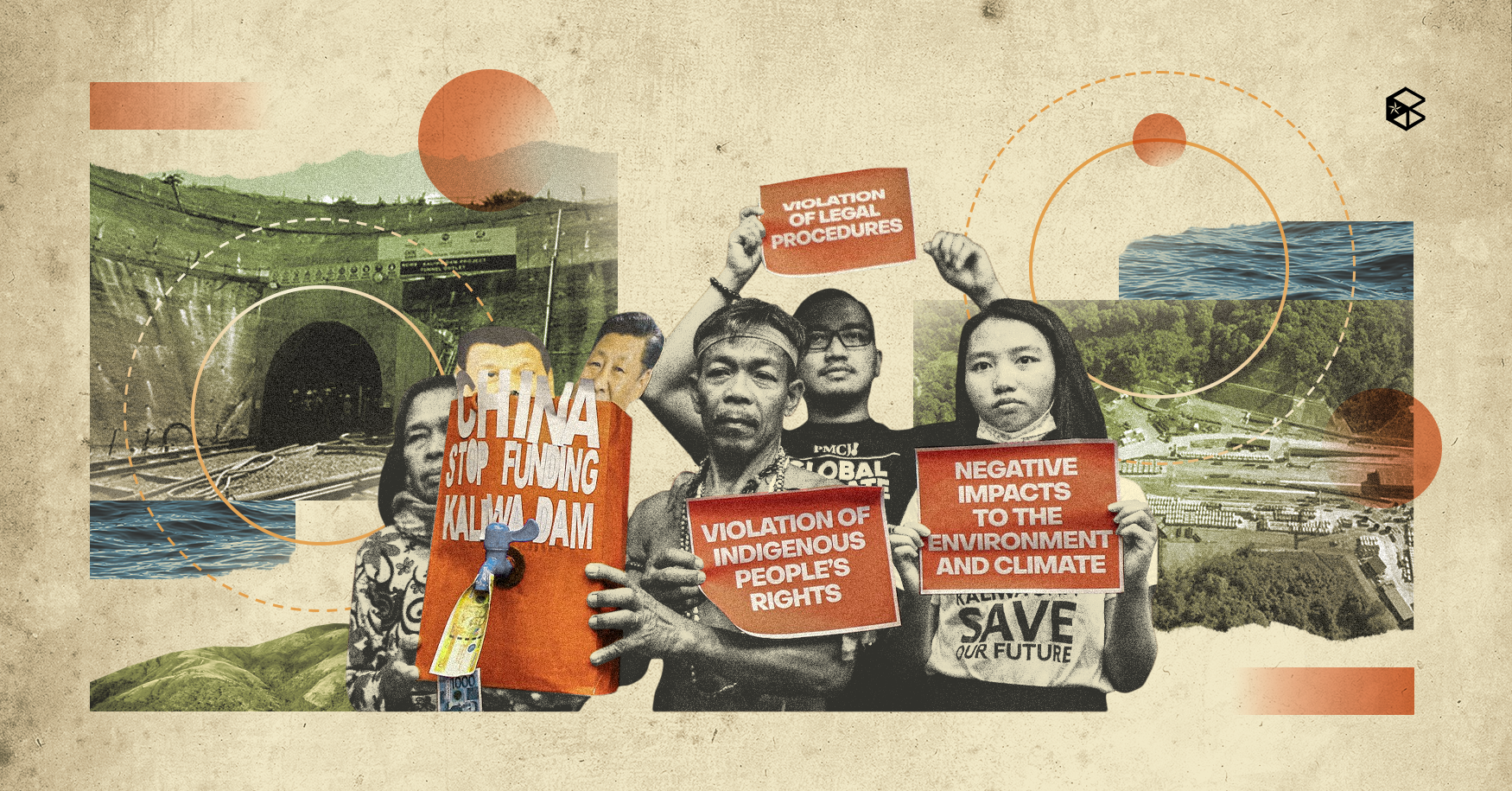




Metro Manila’s water security remains dependent on the aging Angat Dam, which supplies 90% of its water, and worsening climate-induced shortages. In response, the ₱12.2 billion, Chinese-funded Kaliwa Dam project was launched to avert collapse. Designed to deliver 600 million liters of water per day, and slated for completion, will it solve the crisis or submerge sacred and ancestral lands, and erase the history of communities in General Nakar and Infanta, Quezon Province?
The controversial Kaliwa Dam project was first proposed in the 1970s, but construction did not receive approval from the National Economic and Development Authority (NEDA) until 2014. Originally intended as a public-private partnership, the project’s financing was revised in 2017 to rely on official development assistance.
In 2019, the Philippine government secured a $283.2 million loan from China to fund the project, placing it under the former President Duterte’s Build, Build, Build program. The financing agreement drew scrutiny for its terms and the speed of approvals, even as questions over environmental safeguards and indigenous consent continued to surface.
Framed by the government as a technical and urgent response to recurring water shortages, the project has been fast-tracked as a critical infrastructure solution. Persistent opposition from indigenous communities and environmental groups argues that its social and ecological costs remain unresolved.
Nine days of outcry met with silence
When indigenous leaders arrived in Manila after a nine-day protest march in February 2023, they expected to be heard and gain an audience with President Ferdinand Marcos Jr., but instead, they were barred from entering Malacañang.
In an interview with The Benildean, Ricardo Turgo, President of Samahan ng mga Katutubong Agta-Dumagat-Remontado na Binabaka at Ipinagtatanggol ang Lupaing Ninuno (SAGIBIN), recollected their memory of the alay lakad in the years 2009 and 2023.
What began as a protest against the Laiban Dam in Tanay, Rizal, was repeated years later in a grueling march from Rizal to Manila to oppose the Kaliwa Dam project. Despite the physical toll and symbolic weight of the journey, they were met with disappointment.
“Pagdating namin sa Malacañang hindi kami pinapasok. Hindi kami pinapasok doon sa mismong compound. Dito lang kami sa bandang Mendiola lang nakaabot.”
For nine relentless days, the indigenous communities of Rizal and Quezon marched on foot in protest. After all, it is their voice that should matter most especially when their culture, history, and ancestral lands are at stake for the very existence of development.
Turgo fears that while the dam’s construction already threatens the indigenous communities, its completion could be even more devastating. Not just two, but three municipalities in Quezon Province risk being submerged under the massive reservoir the Kaliwa Dam will create if structural damage or failure occurs.
“Isang malaking pinapangamba namin ay ‘yung… pagkasira nung proyekto dahil ‘pag ‘yan ay nasira at biglang nabutas, ‘yung tubig, ‘yung harang, malaki [ang] magiging epekto dito sa tatlong bayan ng General Nakar, Infanta, tapos posible na [rin] ang Real ay maapektuhan din. Ilang tonelada ang maaari na ibuhos kung [ang dam ay] sakaling mabutas,” Turgo said.
When asked about the significance of this fight for their community, Crisanto Dela Carzada, a chieftain from Maksa shared with The Benildean, “Amin po lang isinasalba po ‘yung buhay po at kabuhayan naming mga katutubo dahil ‘pag natuloy po ang dam, lahat po ay maaapektuhan. ‘Yung aming kabuhayan, ‘yung palengke namin, [at] tsaka po ‘yung aming hanapbuhay, mas higit pong maaapektuhan.”
Turgo added, “Ang kahulugan nitong… ginawang alay lakad ay ‘yung maaaring maging epekto doon sa salinlahi pa namin. Mga batang maliliit pa [lang] o ‘yung mga anak nila, mga ina-apo namin… ang [maapektuhan] nito.”
For them, those nine days cost not only their present but also the future of their children and generations to come.
Due process
Before the government can commence infrastructure projects on ancestral lands, a rigorous process securing a free, prior and informed consent (FPIC) is required under the Indigenous Peoples’ Rights Act of 1997.
The Indigenous Peoples’ Rights Act of 1997 is a landmark law that seeks to recognize, protect, and promote the rights of Indigenous Cultural Communities and Indigenous Peoples. It also created the National Commission on Indigenous Peoples, outlined mechanisms for implementing these rights, and allocated government funding for related programs.
The MWSS is required to secure approval from affected communities to proceed legally with the Kaliwa Dam project. MWSS administrator Leonor Cleofas said all permits had been obtained, including separate agreements with the indigenous peoples (IPs) of Rizal and Quezon, whose lands are distinct ancestral domains. But the IP communities say otherwise, denouncing the approvals as “false consent” and challenging the project’s legitimacy on their ancestral lands.
When asked if they think the MWSS followed due process for the approval of this project, Ramcy Astoveza, former Commissioner of the National Commission on Indigenous Peoples (NCIP), answered “No” in an exclusive interview with The Benildean.
After his stint at the NCIP, Astoveza was among the complainants for the case. However, the case was dismissed due to technicalities rather than the merit of the case. They were hoping for the Supreme Court to review the merit of the case, hence their ongoing efforts to be heard and seen by the judicial body.
In another exclusive interview, Marlon Astoveza, chieftain of the Maksa community, expressed the same sentiment with The Benildean that the process was done without proper consent and due process.
“Hindi po dumaan sa mahusay na proseso ang FPIC at [dahil dito] malaki po ‘yung nalabag sa amin bilang pamayanan. Nawalan po kami, kagaya ko po, ‘yung tribo, nawawalan po kami ng karapatan na magdesisyon bilang isang pamayanan dahil ito ay dinadala nila sa mas pinaliit na balangkas. Kung ako po ang titingin, ay mali po ‘yun dahil hindi po makatwiran para sa aming mga katutubo.”
A streak of peace and coexistence
Contrary to common assumptions that only sacred places and the displacement of indigenous communities will be the only tangible impacts of the projects, it extends to even the internal structures built within the communities.
MWSS Administrator Emmanuel Salamat said, in a report by Rhodina Villanueva of The Philippine Star, that they would coordinate with local government units to provide housing for families displaced by the project. The affected families amount to around 400 IP households that are settled in 55 barangays.
However, buried beneath these solutions lie a reality faced by the indigenous people.
Astoveza expressed, “Akala ng mas marami pisikal [na aspeto] ang ililipat lamang. Hindi nakikita ‘yung indigenous political system o structure [dahil masisira] rin siya.” If two communities were to share a single territory, complications on leadership operations may occur.
“Magsasama roon ang dalawang komunidad [kaya magiging] dalawa ngayon ang chieftain o kaaksaan doon sa isang maliit na compound. Ibig sabihin pagkakaguluhin mo sila sa pamamahala ng mga tao roon sa loob dahil inipon mo ‘yung dalawang komunidad sa iisang area lamang,” the former commissioner stated.
The risk of tribal wars also caused concerns, especially for the youth of the Dumagat-Remontado tribe. In a conversation with Kristel Quierrez-Asa, a member of the Maksa community, she shared that, in the tribe’s history, no internal wars have ever occurred; however, the project could potentially disrupt this long-standing peace.
“Kasi ‘yung Dumagat-Remontado tribe, kaming indigenous communities, wala kaming history of tribal war. So, baka dahil diyan sa project na ‘yan magkaroon [nito] at sa generation pa namin.” Quierrez-Asa states that the youth has been constantly doing its part regardless of whether or not they are affected by the project.
The looming effects of this crisis extend far beyond today, the present time. For Turgo, Crisanto, Ramcy Astoveza, Marlon Astoveza, and Quierrez-Asa, the dam is more than a project—it is a threat to their lives, their heritage, and the future of generations yet to come. The cost of silence is theirs alone to bear.
This is a story of our time, and one that the next generation will still bear witness to.
The Kaliwa Dam is expected to be completed by the end of 2026. This is still an ongoing story.
